







SKYNET is HERE: Killer Robot Army In Use
Robots To Patrol Super Bowl - Should We Worry?
It is widely known now that Pentagon has already deployed SWORD robot warriors to slaughter more Iraqis, but now with the increasing bad PR going around about a scary robotized society, the military industrial complex (Northrop Grumman Corp. is a key player) is sending out some friendly robots to let the people know that robots can look after your kids during the football game, and not just mow people down with their laser-precision machine guns.

The MILITARY INDUSTRIAL COMPLEX

****************************************
Robots ready for Super Bowl kickoff
****************************************Washington Technology
By Alice Lipowicz
02/01/08
http://www.washingtontechnology.com/online/1_1/32185-1.html
Arizona law enforcement agencies will use robots to help maintain security at the Super Bowl to be held Feb. 3 at the University of Phoenix Stadium.
Northrop Grumman Corp. will provide support and repair services for the robots, produced by its Remotec Inc. division.
The robots will assist officers on patrol in a two-square-mile security zone around the stadium. They will assist the Phoenix and Glendale, Ariz. Police departments as well as other federal, state and local agencies at the game.
"We're here to support the event and hopefully go unnoticed by fans. Our job isn't to be a disruption but to keep danger at a distance," said Mack Barber, president of Remotec, an operating unit of Northrop Grumman's Mission Systems sector.
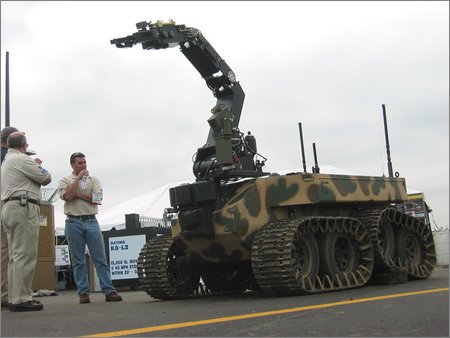
The robots are about 3 feet high and move on wheels. Some will be in the public view and possibly patrolling with officers, and some will be in enclosed areas and only brought out if they are needed, said Northrop Grumman spokesman George Seffers.
Northrop Grumman builds robots for handling hazardous materials and other risky jobs. The robots typically help fire and police departments with explosive disposal units and hazardous material cleanup.
Northrop Grumman of Los Angeles ranks No. 3 on Washington Technology's 2007 Top 100 list of the largest federal government prime contractors.


Defense Advanced Research Projects Agency (DARPA) = THE REAL LIFE SKYNET!

THEY ARE HERE!

DARPA's robotic hand
*************************************************
Gallery: Inside the Navy's Armed Killer Robot Labs
*************************************************Wired.com
By Dave Bullock
01.31.08 | 3:40 PM
SAN DIEGO -- The Navy's MDARS-E is an armed robot that can track anything that moves. Told that I was the target, the unmanned vehicle trained its guns on me and ordered, "Stay where you are," in an intimidating robot voice. And yes, it was frightening.
Perched atop a strip of cliffs lining a beautiful section of the Pacific Ocean, the Space and Naval Warfare System Command in San Diego develops semiautonomous armed robots for use in combat by the U.S. military. "We're not building Skynet" says Bart Everett, the technical director for robotics at SPAWAR. Though Everett assured me that the use of the robots' on-board weapons is under the strict control of their operators, the lab's bots can navigate and map complicated terrain, work cooperatively with soldiers and identify and confront hostile targets. Sure, they're no Johnny Five, but robots with guns are both creepy and fascinating.
Want To Submit A Wacky Crazy Killer Robot Idea To DARPA ? Click!


The vehicle model that SPAWAR demonstrated for us was outfitted with nonlethal weapons. These pneumatic robotic guns (top left and top right) fire munitions that are like paint balls with fins to increase distance and accuracy. Some of these pellets can mark targets or release pepper spray on contact.
The MDARS-E uses a stereoscopic robotic camera system for navigation (bottom left) as well as cameras mounted on the weapons for targeting. A LADAR system (bottom right) uses 24 beams to build an image of the surrounding terrain.


At left, Fire Controlman 2nd Class Mendel Baker tests a communication module for a robot damaged in theater. Normally one working robot can be reassembled using parts salvaged from three broken bots.
..://www.wired.com/images/slideshow/2008/01/spawar/08_wireless_chain.jpg">
Most of the current generation robots in service in Iraq are controlled wirelessly. To extend the range control, SPAWAR researchers developed a self-deploying wireless repeater payload. The robot shoots these spring-loaded repeater modules out their tail ends and they pop open to reveal an elevated antenna (right). The researchers are currently working on a smaller and more rugged version of this system. 


This poster hangs in the SPAWAR offices and gives perspective on the exponential leaps forward in robot autonomy over a relatively short amount of time. View the Evolving Paradigms of Human-Robot Interaction poster (pdf).
Few people realize that military robots and humans have been interacting since World War II when the Germans used remote controlled tanks in battle (while staying within eyesight of the vehicle). These were teleoperated vehicles, just like those used in Iraq and Afghanistan today.
In the SPAWAR laboratory, human-robot interaction has come a long way, especially in the last three years, as robots have gone from mapping an area by themselves (full autonomy), to mapping and then leading a human through an area (semiproximal autonomy), to working fully with a human partner (proximal autonomy). You've come a long way, robo-baby.
Photo: Dave Bullock/Wired
SWORD robots already deployed to kill Iraqis - an experiment before US citizens see them patrolling their streets!


Robot Killers Can Replace Real Soldiers
After seeing the demonstration below, imagine the day when they deploy these Robotex killers roaming the streets during Martial Law and mow us down with deadly gas-powered AA-12 super shotguns?
*****************************************
Robotex killer robot CGI Demo
THIS IS JAMES CAMERON'S NIGHTMARE - SKYNET! SO IS DARPA!
AUTOMATION OF COMBAT SYSTEMS WITH KILLER ROBOTICS!
THIS WILL BE THE BIGGEST THREAT TO HUMAN KIND IN A POST NUCLEAR HOLOCAUST!
AUTOMATION OF COMBAT SYSTEMS WITH KILLER ROBOTICS!
THIS WILL BE THE BIGGEST THREAT TO HUMAN KIND IN A POST NUCLEAR HOLOCAUST!


US Army Future Combat Systems FCS Official Site

******************************
Defense Focus: FCS follies
******************************Are the cyber-pigeons coming home to roost?
Washington (UPI)
by Martin Sieff
Jan 28, 2007
For the past 2-1/2 years, we have been reporting in these columns about the growing problems generating by former Defense Secretary Donald Rumsfeld's visionary Future Combat Systems program to make the U.S. armed forces unbeatable in the 21st century.
FCS had the ambitious vision of integrating the firepower of combat forces of the U.S. Army through a wireless network in real time. It offered the prospect of field commanders video conferencing with front-line officers in tanks on the battlefield. It offered the vision of minimizing combat casualties by sending in large numbers of robots to defuse mines and open ways through battlefields.
The program was one of the most costly in the history of the U.S. Army. The Washington Post Friday said its estimated cost was $200 billion. As we have previously reported in these columns, some estimates from the Congressional Budget Office and the Government Accountability Office have already gone 50 percent higher than that. And even those estimates assumed that the basic concepts of the program were sound and that it would work as projected.
In fact, as the Post reported Friday, the number of lines of software code required by the project has more than doubled in only the past five years. The Army originally reckoned it needed 33.7 million lines of code. Now it reckons it needs 63.8 million. The paper also cited Dennis Muilenberg, Boeing's project manager on the FCS, as maintaining that the original estimate was 55 million lines of software, not 33 million.
No one doubts that interconnectivity and rapid response is vital on the battle field. No one doubts the U.S. armed forces have enjoyed a decisive global superiority in applying these key technologies over the past quarter century. And no one with any sense doubts that it should be a top priority goal to seek to retain that advantage through the coming decades.
But as we have warned in these columns before, the FCS from the very beginning appeared doomed to failure: It sought to replace the flexibility easily available in modern off-the-shelf communications technology with enormously ambitious and rigid integrated goals that swallowed up limitless resources.
Yet, as we reported 2-1/2 years ago, three-star Army generals were cautiously warning back in August 2005 that the very concept of the FCS leaves it dangerously vulnerable to cyber-attack -- a form of asymmetrical warfare that China in particular has given top priority to, and that is also being developed energetically by Russia and India.
These concerns have since become more widespread. The Post report cited a warning from the Defense Science Board, which advises the Office of the Secretary of Defense, as saying last year, "Malicious code is a key concern of the FCS program (and it) lacks confidence in current tools for detecting malicious code."
In other words, the key strategic conception for continuing U.S. battlefield superiority for at least 20 years to come depends on an integrated software system that is still being developed, and that is certain to be vulnerable to hostile cyber-attacks even when it is finally completed.
But that is only the first of the strategic and conceptual problems that the FCS mega-project faces. There are even more fundamental ones.
Labels: Critical Thinking, DARPA, Depopulation, EMF, False Flag, Fascism, Microwave, Militarism, New World Order, Supression, Surveillance Society, Totalitarian, Tyranny
posted by Ma Justice | 4:44 PM
|
0 comments

